STEMSIT
STEM Social Issue Topics

STEMSIT
HEART
BODY PART
ENJOY
COME
READ
LEARN NEW
ACCURATE INFORMATION
DISCOVER MORE ABOUT
YOUR BODY
GAIN KNOWLEDGE
FACTS
HEART
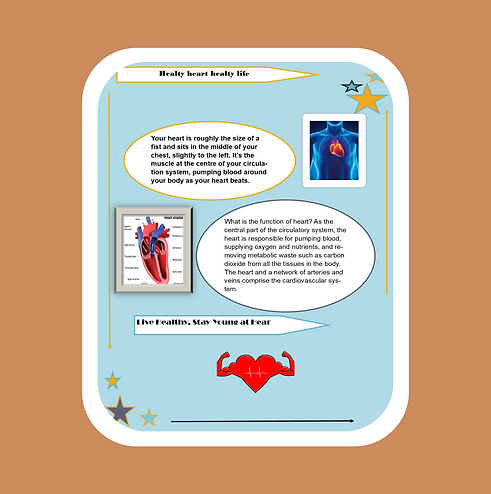
Your heart, located in the middle of your chest and protected behind your ribs, is one of the most important organs in your body

heart
It's the muscle at the centre of your circulation system, pumping blood around your body as your heart beats. This blood sends oxygen and nutrients to all parts of your body, and carries away unwanted carbon dioxide and waste products.

Purpose
Your heart is the primary organ of your circulatory system. It pumps blood throughout your body, controls your heart rate and maintains blood pressure

Function
The four main functions of... Pumping oxygenated blood to other body parts. · Pumping hormones and other vital substances to different parts of the body. Receiving deoxygenated blood and carrying metabolic waste products from the body and pumping it to the lungs for oxygenation. Maintaining blood pressure.
PART OF THE HEART

1
Aorta
is the main and largest artery in the human body, originating from the left ventricle of the heart and extending down to the abdomen, where it splits into two smaller arteries (the common iliac arteries). The aorta distributes oxygenated blood to all parts of the body through the systemic circulation
2
left atrium
The left atrium is one of the four chambers of the heart, located on the left posterior side. Its primary roles are to act as a holding chamber for blood returning from the lungs and to act as a pump to transport blood to other areas of the heart. The walls of the left atrium are slightly thicker than the walls of the right atrium. Oxygen-rich blood from the lungs enters the left atrium through the pulmonary vein. The blood is then pumped into the left ventricle chamber of the heart through the mitral valve.
3
right atrium
The right atrium is one of the four chambers of the heart. The heart is comprised of two atria and two ventricles. Blood enters the heart through the two atria and exits through the two ventricles. Deoxygenated blood enters the right atrium through the inferior and superior vena cava. The right side of the heart then pumps this deoxygenated blood into the pulmonary arteries around the lungs.
4
superior vena cava
The superior vena cava is one of the primary veins within our bodies. It transports blood from our arms, chest, neck, and head to our hearts. In superior vena cava syndrome (SVCS), this vein has become obstructed or compressed to some degree. One of the main causes of SVCS is cancer.
5
Right and Left Heart Ventricle
The two ventricles of the heart are known as the right and left ventricles. The left ventricle is defined as the one located on the left side of the heart and left side of the body anatomically. The right ventricle of the heart is defined as the one located on the right side of the heart and right side of the body anatomically.
The Most Common heart diseases
heart attack
A heart attack - also known as myocardial infarction or MI - happens when the blood supply to part of your heart muscle becomes completely blocked. This is most commonly caused by a piece of fatty material breaking off and a blood clot forms within a coronary artery. This can cause damage to the part of your heart muscle which that particular coronary artery was supplyin
heart failure
If the heart’s pumping action can’t work effectively, your heart muscle can’t meet your body’s demand for blood and oxygen, and your body develops various different symptoms, like fatigue and shortness of breath. This is called heart failure because of the failure of your heart to work efficiently
valve diseases
If the heart’s pumping action can’t work effectively, your heart muscle can’t meet your body’s demand for blood and oxygen, and your body develops various different symptoms, like fatigue and shortness of breath. This is called heart failure because of the failure of your heart to work efficiently
Congenital heart conditions
Congenital heart conditions occur when there’s an abnormality or defect with the structure of the heart of a developing foetus while inside the mother’s womb. A baby may be born with only one defect or with several defects. Some types of congenital heart defects are life-threatening, either immediately to the newborn or over time.
Inherited heart conditions
\Inherited conditions can be passed on through families. They are sometimes called familial or genetic heart conditions. They can affect people of any age and can be life-threatening. The first sign there’s a problem is often when someone dies suddenly with no obvious cause. These conditions are different from most congenital heart conditions, although some congenital conditions can also be inherited.
Keep Your heart Healthy

Many people do not realize it, but lifestyle is the biggest contributor to how healthy one's heart is. The things people eat, the things they drink and the things they smoke all impact heart health. Leisure activities, activity levels and even the environment, can affect the heart. It is important to learn the things any individual can control to promote better health
How Does Exercise Strengthen the heart?
The Benefits of Exercise
Improves the muscles' ability to pull oxygen out of the blood, reducing the need for the heart to pump more blood to the muscles. Reduces stress hormones that can put an extra burden on the heart. Works like a beta blocker to slow the heart rate and lower blood pressure.
When you are physically active, your heart work harder to supply the additional oxygen your muscles demand. Just like regular exercise makes your muscles stronger, it also makes your lungs and heart stronger. As your physical fitness improves, your body becomes more efficient at getting oxygen into the bloodstream and transporting it to the working muscles. That's one of the reasons that you are less likely to become short of breath during exercise over time. Some types of exercise can also strengthen the muscles of the neck and chest, including the diaphragm and muscles between the ribs that work together to power inhaling and exhaling.
Physical activity is very important in a heart care regimen. Doctors recommend getting at least two and a half hours of physical activity each week. Exercise makes a person stronger, helps with balance and increases flexibility. More than that, it improves cardiovascular function. The heart learns to work more efficiently and gets stronger..
Exercising with heart Disease
How can I keep my respiratory system healthy?
Choose an aerobic activity such as walking, swimming, light jogging, or biking. Do this at least 3 to 4 times a week. Always do 5 minutes of stretching or moving around to warm up your muscles and heart before exercising. Allow time to cool down after you exercisIt is important to work with your healthcare team to make a fitness plan that works for you.
If you’re like many people, you take shallow breaths from your chest area, using only a small portion of your lungs. Deep breathing helps clear the lungs and creates a full oxygen exchange.hey found that there was a significant increase in vital capacity after 2 and 5 minutes of deep breathing exercise. Vital capacity is the maximum amount of air the volunteers could exhale from their lungs. The researchers concluded that deep breathing, even for just a few minutes, was beneficial for lung function.Shallow breaths come from the chest, and deeper breaths come from the belly, where your diaphragm sits. Be aware of your belly rising and falling as you practice. When you do these exercises, you may also find you feel less stressed and more relaxed
When should I call a healthcare provider about an issue with my respiratory system?
Heart care is not something to joke about or take lightly. Most people want to live long, full lives with their loved ones. To get the most out of life and have a good chance at living the full life you have dreamed of, take your heart health seriously.
STAY HEALTHY
CITATIONS:
heart attack
"Heart attack | NHS inform" https://www.nhsinform.scot/illnesses-and-conditions/heart-and-blood-vessels/conditions/heart-attack
heart failure
Heart failure - Illnesses & conditions | NHS inform" https://www.nhsinform.scot/illnesses-and-conditions/heart-and-blood-vessels/conditions/heart-failure/
valve diseases
Heart Information & Support - Chest Heart & Stroke Scotland" https://www.chss.org.uk/heart-information-support/
highblood pressu
"High blood pressure (hypertension) - Illnesses & conditions | NHS inform" https://www.nhsinform.scot/illnesses-and-conditions/heart-and-blood-vessels/conditions/high-blood-pressure-
congenintal heart conditions
"Congenital heart conditions - Illnesses & conditions | NHS inform" https://www.nhsinform.scot/illnesses-and-conditions/heart-and-blood-vessels/conditions/congenital-heart-disease/
in herited heart conditions
"Inherited heart conditions - Illnesses & conditions | NHS inform" https://www.nhsinform.scot/illnesses-and-conditions/heart-and-blood-vessels/conditions/inherited-heart-conditions/
cornarry heart disease
"Coronary heart disease - Illnesses and conditions | NHS inform" https://www.nhsinform.scot/illnesses-and-conditions/heart-and-blood-vessels/conditions/coronary-heart-disease/
aotra
"Your Aorta: The Pulse of Life | American Heart Association" https://www.heart.org/en/health-topics/aortic-aneurysm/your-aorta-the-pulse-of-life
left atrium
Right Atrium Function, Definition & Anatomy | Body Maps" https://www.healthline.com/human-body-maps/right-atrium
right atium
"Left Atrium Function, Definition & Anatomy | Body Maps" https://www.healthline.com/human-body-maps/left-atrium
"The Superior Vena Cava - TeachMeAnatomy" https://teachmeanatomy.info/thorax/vasculature/superior-vena-cava/
right and left ventricle
heart
https://www.cardio.com/blog/understanding-your-heart-and-how-it-functions
angina \
part of heart
https://www.freepik.com/premium-vector/parts-heart-diagram_2440321.htm
basic heart anatomy