STEMSIT
STEM Social Issue Topics

STEMSIT
EYES
BODY PART
ENJOY
COME
READ
LEARN NEW
ACCURATE INFORMATION
DISCOVER MORE ABOUT
YOUR BODY
GAIN KNOWLEDGE
FACTS
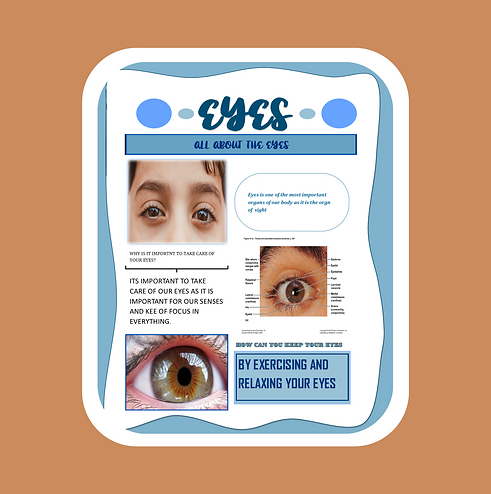
EYES
Eyes are organs of the visual system.

Eyes
Your eyes are organs that allow you to see. They take in light from the world around you and send visual information to your brain. Your eyes can see about 200 degrees in all directions, including in front of you and to the sides (peripheral vision). Parts of your eyes work together to allow you to see images, movement and depth. Your eyes can see millions of colors in varying shades.

Purpose
The main purpose of the organ, The eye is a sensory organ. It collects light from the visible world around us and converts it into nerve impulses. The optic nerve transmits these signals to the brain, which forms an image so thereby providing sight.

Function
The Function of the eye is for us to see colors and give signal to our brain to see and identify objects around us, it collects light from the visible world around us and convert it into nerve impulses, it is important when it comes to our physical senses, it also improve brain focus
PARTS OF THE EYE

Different parts of the eyes and its diffinition: INTERNAL
1
Retina
The retina is the part of the eye which converts light into neural signals. It is the innermost, light-sensitive layer of tissue of the eye of most vertebrates and some molluscs. The optics of the eye create a two-dimensional image of the visual world on the retina; Some of the image is in focus and some of the image is out of focus. The retina processes the image and sends nerve impulses along the optic nerve to the visual cortex to create visual perception.
2
Lens
The lens, or crystalline lens, is a transparent biconvex structure in the eye that, along with the cornea, helps to refract light to be focused on the retina. By changing shape, it functions to change the focal length of the eye so that it can focus on objects at various distances, thus allowing a sharp real image of the object of interest to be formed on the retina. This adjustment of the lens is known as accommodation.
3
Cornea
The cornea is the transparent front part of the eye that covers the iris, pupil, and anterior chamber. Along with the anterior chamber and lens, the cornea refracts light, accounting for approximately two-thirds of the eye's total optical power. In humans, the refractive power of the cornea is approximately 43 dioptres.The cornea can be reshaped by surgical procedures such as LASIK.
4
Iris
The iris consists of two layers: the front pigmented fibrovascular layer known as a stroma and, beneath the stroma, pigmented epithelial cells. The stroma is connected to a sphincter muscle (sphincter pupillae), which contracts the pupil in a circular motion, and a set of dilator muscles (dilator pupillae), which pull the iris radially to enlarge the pupil, pulling it in folds. The sphincter pupillae is the opposing muscle of the dilator pupillae. The pupil's diameter, and thus the inner border of the iris, changes size when constricting or dilating. The outer border of the iris does not change size. The constricting muscle is located on the inner border.
5
Pupil
The pupil is a black hole located in the center of the iris of the eye that allows light to strike the retina. In humans, the pupil is round, but its shape varies between species; some cats, reptiles, and foxes have vertical slit pupils, goats have horizontally oriented pupils, and some catfish have annular types. The pupil is a hole located in the center of the iris of the eye that allows light to strike the retina.[1] It appears black because light rays entering the pupil are either absorbed by the tissues inside the eye directly, or absorbed after diffuse reflections within the eye that mostly miss exiting the narrow pupil
Parts of the eye: EXTERNAL
1
Eyelash
An eyelash (also called lash) (Latin: Cilia) is one of the hairs that grows at the edge of the eyelids. It grows in one layer on the edge of the upper and lower eyelids. Eyelashes protect the eye from debris, dust, and small particles and perform some of the same functions as whiskers do on a cat or a mouse in the sense that they are sensitive to being touched, thus providing a warning that an object (such as an insect) is near the eye (which then closes reflexively).
2
Eyelid
An eyelid is a thin fold of skin that covers and protects an eye. The levator palpebrae superioris muscle retracts the eyelid, exposing the cornea to the outside, giving vision. This can be either voluntarily or involuntarily. The human eyelid features a row of eyelashes along the eyelid margin, which serve to heighten the protection of the eye from dust and foreign debris, as well as from perspiration. "Palpebral" (and "blepharal") means relating to the eyelids. Its key function is to regularly spread the tears and other secretions on the eye surface to keep it moist, since the cornea must be continuously moist.
COMMON EYE DISEASES AND DISORDERS
Astigmatism
Astigmatism is a type of refractive error due to rotational asymmetry in the eye's refractive power. This results in distorted or blurred vision at any distance. Other symptoms can include eyestrain, headaches, and trouble driving at night. Astigmatism often occurs at birth and can change or develop later in life. If it occurs in early life and is left untreated, it may result in amblyopia. The cause of astigmatism is unclear; however, it is believed to be partly related to genetic factors. The underlying mechanism involves an irregular curvature of the cornea or abnormalities in the lens of the eye. Diagnosis is by an eye examination, through objective and subjective refraction.
Cataract
A cataract is a cloudy area in the lens of the eye that leads to a decrease in vision. Cataracts often develop slowly and can affect one or both eyes. Symptoms may include faded colors, blurry or double vision, halos around light, trouble with bright lights, and trouble seeing at night. This may result in trouble driving, reading, or recognizing faces. Poor vision caused by cataracts may also result in an increased risk of falling and depression. Cataracts cause 51% of all cases of blindness and 33% of visual impairment worldwide.
Macular Degeneration
Macular degeneration, also known as age-related macular degeneration (AMD or ARMD), is a medical condition which may result in blurred or no vision in the center of the visual field. Early on there are often no symptoms. Over time, however, some people experience a gradual worsening of vision that may affect one or both eyes. While it does not result in complete blindness, loss of central vision can make it hard to recognize faces, drive, read, or perform other activities of daily life. Visual hallucinations may also occur but these do not represent a mental illness.
Glaucoma
Glaucoma is a group of diseases that can damage the eye’s optic nerve and result in vision loss and blindness. Glaucoma occurs when the normal fluid pressure inside the eyes slowly rises. However, recent findings now show that glaucoma can occur with normal eye pressure. With early treatment, you can often protect your eyes against serious vision loss. There are two major categories “open angle” and “closed angle” glaucoma. Open angle, is a chronic condition that progress slowly over long period of time without the person noticing vision loss until the disease is very advanced, that is why it is called “sneak thief of sight.”
Amblyopia
Amblyopia, also referred to as “lazy eye,” is the most common cause of vision impairment in children. Amblyopia is the medical term used when the vision in one of the eyes is reduced because the eye and the brain are not working together properly. The eye itself looks normal, but it is not being used normally because the brain is favoring the other eye. Conditions leading to amblyopia include strabismus, an imbalance in the positioning of the two eyes; more nearsighted, farsighted, or astigmatic in one eye than the other eye, and rarely other eye conditions such as cataract.
Strabismus
Strabismus involves an imbalance in the positioning of the two eyes. Strabismus can cause the eyes to cross in (esotropia) or turn out (exotropia). Strabismus is caused by a lack of coordination between the eyes. As a result, the eyes look in different directions and do not focus simultaneously on a single point. In most cases of strabismus in children, the cause is unknown. In more than half of these cases, the problem is present at or shortly after birth (congenital strabismus). When the two eyes fail to focus on the same image, there is reduced or absent depth perception and the brain may learn to ignore the input from one eye, causing permanent vision loss in that eye (one type of amblyopia).
Blurry Vision
Temporary blurred vision may involve dry eyes, eye infections, alcohol poisoning, hypoglycemia, or low blood pressure. Other medical conditions may include refractive errors such as myopia, high hypermetropia, and astigmatism, amblyopia, presbyopia, pseudomyopia, diabetes, cataract, pernicious anemia, vitamin B12 deficiency, thiamine deficiency, glaucoma, retinopathy, hypervitaminosis A, migraine, sjögren's syndrome, floater, macular degeneration, and can be a sign of stroke or brain tumor
Keep Your Eyes Healthy

You already know that physical exercise is good but you also need to exercise your eyes and give it a rest from time to time to prevent diseases and to improve eyesight
Why does exercising and resting good for your eyes?
The Benefits of it
Cardiovascular exercises such as aerobics will lower intraocular pressure which pressures the eyes and it helps to keep the retinal galion protected
By resting your eyes, you are allowing your optic nerve to rest by not being stimulated outside images, resting your eyes can relax your entire body, relax your eyes and try to blink more often. All of this helps you to have better eyesight
Prevent Eye Diseases
How Can I Keep my Eyes Healthy
As we all know that some of physical and internal related diseases and actions can also trigger some eye conditions, such as Cataract, Astigmatism and many more that can blur your vision or make you go blind, to make sure that your eyes is healthy always ingage in physical exercise, healthy diet and more sleep.
-
Avoid dusty and dirty places as the dust can enter the eyes and it may cause irritation
-
Eat a healthy diet with lots of fruits and vegetables and drink water to stay hydrated
-
Exercise regularly and always rest your eyes.
-
Prevent infections by washing your hands.
When should I call a healthcare provider about an issue concerning my eyes?
When you are experiencing sudden irritation, blurry vision and problems focusing, also if it's accompanied by sudden headache,fever and unusual sensitivity to light and if you notice that your vision changes drastically then you should consult your eye doctor for more informations.
alot of intances can cause your eyes to irritate so make sure to do your research strictly dont do DIY remedies as it can also make everything get worsen if done wrong.
STAY HEALTHY
CITATIONS:
STRABISMUS https://medlineplus.gov/ency/article/001004.htm#:~:text=Strabismus%20is%20a%20disorder%20in,known%20as%20%22crossed%20eyes.%22 Blurred Vision https://www.healthdirect.gov.au/amp/article/blurred-vision Retina Retina https://www.mayoclinic.org/diseases-conditions/retinal-diseases/symptoms-causes/syc-20355825#:~:text=The%20retina%20contains%20millions%20of,nerve%2C%20enabling%20you%20to%20see. Lens https://www.britannica.com/science/lens-eye-structure Iris-Cornea https://www.webmd.com/eye-health/picture-of-the-eyes AMBLYOPIA https://www.nei.nih.gov/learn-about-eye-health/eye-conditions-and-diseases/amblyopia-lazy-eye#:~:text=Amblyopia%20(also%20called%20lazy%20eye,the%20sight%20from%201%20eye. Glaucoma https://www.nei.nih.gov/learn-about-eye-health/eye-conditions-and-diseases/glaucoma#:~:text=What%20is%20glaucoma%3F,a%20comprehensive%20dilated%20eye%20exam.